ZEVO Blog


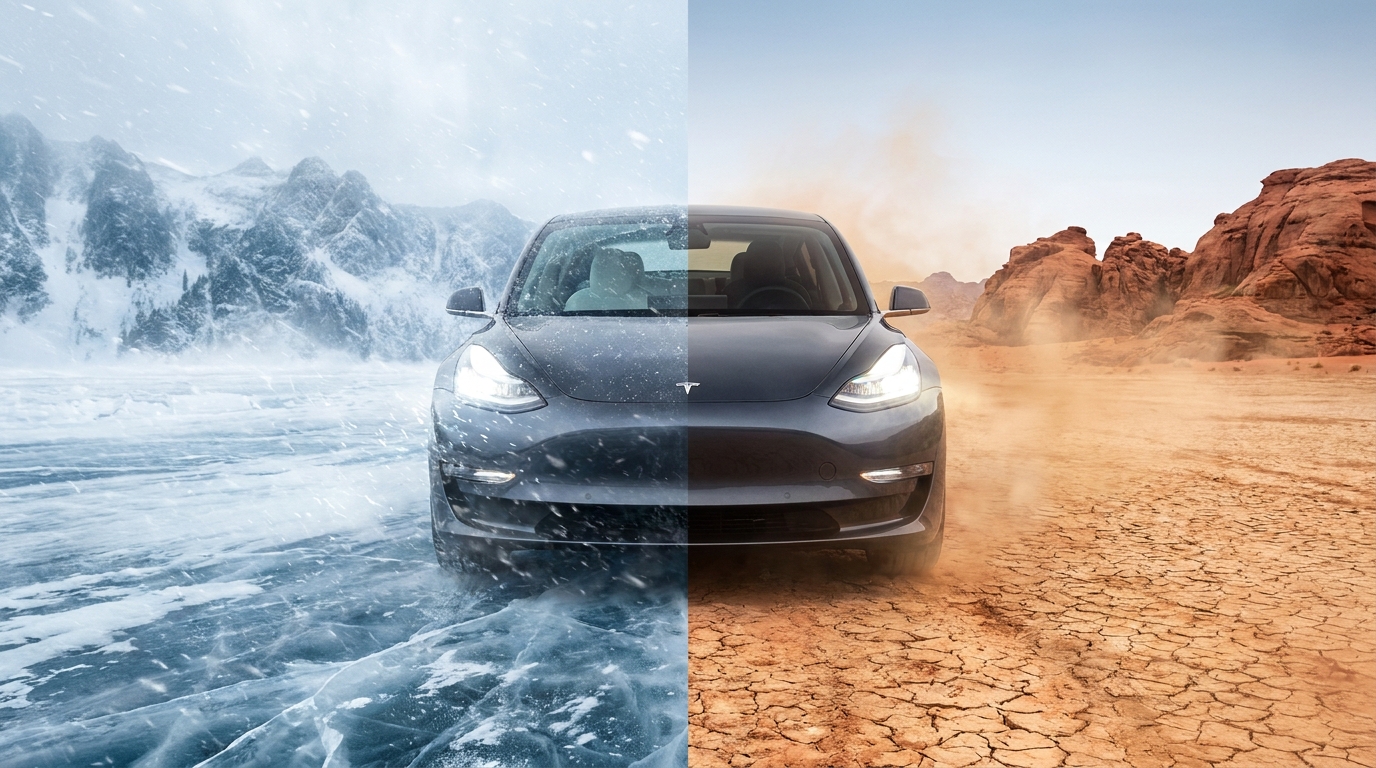
Every time EV adoption comes up, someone brings up the cold. "I heard they don't work in winter." "My cousin said his battery died in the snow." Range anxiety is real — but how much of it is fact, and how much is fear?
AAA just published a fresh round of real-world testing (May 2026), and the results give us something more useful than hot takes: actual numbers. Here's what they found — and what it means for anyone considering an EV.
AAA's automotive engineering team tested six vehicles — three fully electric, three hybrids — at three temperature conditions: a frigid 20°F, a comfortable 75°F, and a sweltering 95°F. The vehicles were tested on a chassis dynamometer (essentially a treadmill for cars) with cabin HVAC set to 72°F throughout, so the car was actively fighting the temperature the whole time. That matters, because it mirrors real driving conditions.
The headline for summer is actually a good news story. EVs lost just 8.5% of their driving range at 95°F compared to ideal conditions — and their overall efficiency (MPGe) dropped 10.4%.
Compare that to AAA's 2019 version of the same test, where heat cut range by 17%. That's nearly half the impact, in just seven years. Modern thermal management systems, improved battery chemistry, and smarter software are making EVs significantly more heat-resilient. This is a real, measurable improvement that often gets overlooked in EV coverage.
For drivers in the Sun Belt, the Southwest, or anywhere summers get brutal: yes, you'll see some range reduction, but it's modest and increasingly well-managed by the vehicles themselves.
Let's not sugarcoat it. Cold is still the bigger challenge. At 20°F, EVs in the AAA study lost 39% of their calculated driving range — and their efficiency dropped 35.6%.
Unlike the heat improvement, cold weather performance hasn't changed much since 2019. Greg Brannon, AAA's director of automotive engineering, put it plainly: "There's been a lot of technology changes — new battery chemistries, more efficient designs, fancier software. But when it comes to winter range performance, the electric vehicles actually didn't change all that much."
That's honest, and it's worth taking seriously. If you're doing a long highway trip in January and your car shows 300 miles of range, plan for something closer to 180 in extreme cold.
But here's the key nuance: this is manageable with planning. Pre-conditioning your vehicle while plugged in (warming the cabin before you leave), keeping the battery charged above 20%, and knowing where chargers are along your route all help significantly. Brannon's conclusion: "It can be overcome. But you have to plan for it."
AAA also crunched the operating cost numbers, and this is where things get interesting for everyday drivers:
The takeaway: home charging is the great equalizer. If you charge at home most of the time (which most EV owners do), you come out ahead even in winter — and well ahead in every other season.
If you're renting an EV through ZEVO — especially in a new climate or for a longer trip — these numbers are worth keeping in mind:
AAA's testing isn't a takedown of EVs — it's a reality check that makes them more accessible. Yes, cold weather hurts range. No, it hasn't gotten better yet. But hot weather? Getting meaningfully easier to handle every year. And the cost math still favors EVs in most real-world scenarios.
The myth isn't that temperature affects EVs — it does, and that's real. The myth is that it makes them impractical. With modern range and some basic trip planning, most drivers handle it just fine.
Ready to try an EV for yourself? Browse available vehicles at web.zevo.com and see what works for your next trip.
